
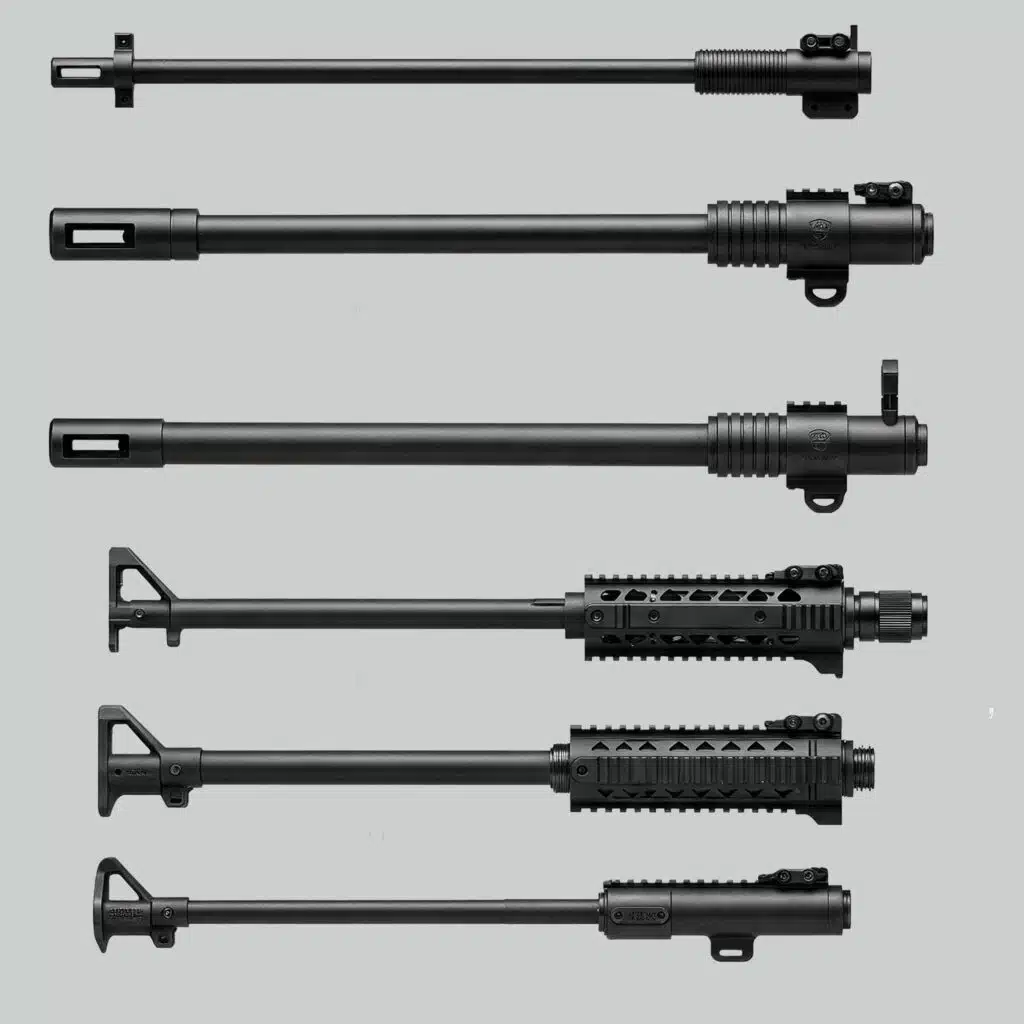

Barrel length is one of the first decisions you make on an AR-15 build, and it affects almost everything downstream — velocity, gas system selection, overall handling, sound signature, even what legal category the firearm falls into. I’ve built uppers across every common barrel length from 7.5 inches up to 20, and the honest truth is there’s no single best length. There’s only the best length for what you’re trying to do.
Let me walk through what actually changes as you go shorter or longer, because there’s a lot of bad information out there — guys on forums quoting velocity numbers they’ve never chronographed, or dismissing short barrels entirely based on something they read once.
Here’s the basic physics. When you fire a round, the powder ignites and creates expanding gas behind the bullet. That gas pushes the bullet down the barrel, accelerating it the entire time the bullet is inside the bore. The longer the barrel, the more time that gas has to push, and the faster the bullet is moving when it exits the muzzle.
But it’s not a linear relationship, and this is where people get tripped up. You don’t gain the same velocity per inch across the entire length. With 5.56 NATO, the biggest velocity gains happen in the first 16 inches or so. Going from a 10.5-inch barrel to a 16-inch barrel, you’ll pick up roughly 200-300 fps depending on the load. Going from 16 inches to 20 inches, you might gain another 100-150 fps. The returns diminish as you add length because the powder charge is mostly spent.
What that means practically: a 16-inch barrel gets you the majority of what 5.56 has to offer in terms of velocity. A 20-inch barrel squeezes out a bit more. And a 10.5-inch barrel is giving up real velocity — but whether that matters depends on what you’re doing at the other end.
We build a lot of short-barreled uppers, particularly in the 7.5-inch and 10.5-inch range for AR pistol configurations. Here’s what you’re getting and what you’re giving up.
What you gain: A compact, maneuverable package. A 7.5-inch 5.56 upper with a collapsed brace is short enough to work in vehicles, doorways, and tight spaces where a full-length rifle is awkward. For home defense, the handling advantage is real. You can move through a hallway with a short-barreled AR in a way that a 16-inch rifle just doesn’t allow.
What you give up: Velocity, and everything that comes with it. A 55-grain 5.56 round out of a 7.5-inch barrel is running somewhere around 2,500 fps versus 3,100+ fps out of a 16-inch barrel. That velocity loss means less effective range, more bullet drop at distance, and reduced terminal performance. Inside 100 yards, it’s still plenty effective. Past 200, you’re starting to notice.
The other thing nobody warns you about until you shoot one: a short-barreled 5.56 is loud. Genuinely, painfully loud. You’re dumping a large volume of unburned powder and high-pressure gas out the muzzle that would have stayed inside a longer barrel. The fireball is impressive. The concussion is significant. If you’re shooting next to other people at a range, they will not love you. A good flash hider or blast can helps, and a suppressor makes a dramatic difference — which is one reason short 5.56 barrels and cans go together so well.
The gas system on a short barrel matters a lot. Most of our 7.5-inch and 10.5-inch uppers run pistol-length gas systems. The port pressure at these barrel lengths is high, which means the bolt carrier is getting hit hard and fast. The rifle will cycle reliably, but the bolt velocity is aggressive. A properly weighted buffer and spring combination makes a big difference here. An adjustable gas block gives you even more control. If a customer tells me they’re building a short 5.56 and plans to suppress it, I always recommend an adjustable gas block — the backpressure from a suppressor on an already overgassed short barrel will beat the gun up unnecessarily if you can’t tune it down.
For short builds, 300 Blackout is worth serious consideration over 5.56. The .300 BLK was literally designed to perform well out of short barrels. It reaches its full velocity potential in about 9 inches of barrel, so a 10.5-inch 300 Blackout isn’t leaving performance on the table the way a 10.5-inch 5.56 is.
Check out our AR-15 pistol upper receivers to see what we’re building in the short barrel range.
If I had to recommend one barrel length for a general-purpose 5.56 AR-15, it’s 16 inches. And I say that as someone who has no financial incentive to push one barrel length over another — we sell them all.
At 16 inches, you’re getting the vast majority of the velocity that 5.56 can deliver. You’re long enough to run a mid-length gas system, which is softer shooting and easier on parts than a carbine-length system. The rifle is still compact enough to be handy in most situations. And critically, 16 inches is the minimum barrel length for a rifle under federal law — no tax stamp, no pistol brace considerations, just a straightforward rifle.
The 14.5-inch barrel is the other popular option in this range. The military’s M4 carbine runs a 14.5-inch barrel, and a lot of people want that same profile. The velocity loss compared to 16 inches is minimal — maybe 50-75 fps. The handling improvement is noticeable. The catch is that a 14.5-inch barrel makes the firearm a short-barreled rifle under the NFA unless you permanently pin and weld a muzzle device to bring the overall barrel length to 16 inches or greater. We can do pin-and-weld jobs in our shop, and it’s a popular request.
For gas system selection at these lengths: a 16-inch barrel pairs perfectly with a mid-length gas system. A 14.5-inch barrel can run either mid-length or carbine-length depending on the specific port location and your priorities. Mid-length will be softer and easier on the bolt; carbine-length will be more proven and have a wider margin for reliability with various ammo types. In our builds, we run mid-length on our 16-inch barrels and it’s been rock solid.
We build 18-inch and 20-inch uppers for customers who want every bit of velocity and accuracy they can get out of the 5.56 platform. These are your precision builds, your SPR-style (Special Purpose Rifle) setups, your coyote and varmint hunting rigs.
A 20-inch barrel with a rifle-length gas system is the original M16 configuration, and there’s a reason it’s been in service since the 1960s. The rifle-length gas system is the smoothest, lowest-pressure gas setup you can run on an AR-15. Bolt carrier velocity is lower, which means less wear on parts over tens of thousands of rounds. Felt recoil is the lightest. The ejection pattern is consistent. It’s just a smooth-running system.
The 18-inch barrel has become popular as a compromise — you get most of the velocity advantage of a 20-inch with a slightly more compact package. An 18-inch barrel typically runs a rifle-length gas system and pairs well with a 15-inch free float handguard for a full-coverage look with a long grip surface. For a precision or DMR (designated marksman rifle) build, the 18-inch is hard to argue against.
Where longer barrels work against you: weight and handling. A 20-inch barrel with a full-length handguard, optic, bipod, and loaded magazine is not a light rifle. If you’re sitting at a bench or in a hide, that’s fine. If you’re hiking with it or moving through brush on a hunt, you’ll feel every inch. It’s a tool for a specific purpose, and within that purpose, it’s excellent.
This comes up enough that it’s worth mentioning. Barrel length and twist rate are separate decisions, but they interact. The twist rate determines which bullet weights your barrel will stabilize. A 1:7 twist stabilizes heavier bullets (62-77 grain) well. A 1:9 twist is better suited for lighter bullets (55 grain). A 1:8 twist is a good all-around compromise that handles 55 through 77 grain reasonably well.
Twist rate doesn’t change with barrel length — a 1:7 twist in a 10.5-inch barrel stabilizes the same bullet weights as a 1:7 in a 20-inch barrel. But velocity does change, and some bullet designs require a minimum velocity to perform as intended (particularly hollow points that need a certain speed to expand). So on a very short barrel, you might be stabilizing a heavy bullet just fine but not driving it fast enough for it to do what it’s supposed to do on impact. That’s worth considering if you’re building a short-barreled gun for defensive use.
We list twist rates on all of our barrel product pages and on every complete upper, so you can match the barrel to the ammunition you plan to run.
After two decades of building these rifles, here’s how I frame it for customers:
7.5 to 10.5 inches — You want maximum compactness. Home defense, vehicle gun, suppressor host. Accept the velocity and blast tradeoffs. Consider 300 Blackout for these lengths.
14.5 inches (pinned and welded) — You want the M4 profile and handling without an NFA stamp. Great all-around choice if you’re willing to commit to a muzzle device.
16 inches — The default answer for most people. Best balance of velocity, handling, gas system options, and legal simplicity. If you’re not sure what you need, start here.
18 to 20 inches — You’re building for precision, long range, or hunting. You want every fps and the smoothest gas system. Accept the weight and length.
There’s no wrong answer as long as the barrel length matches what you’re actually doing with the rifle. If you’re not sure which direction to go for your build, give us a call at (888) 912-6486. We’ll sort it out.