
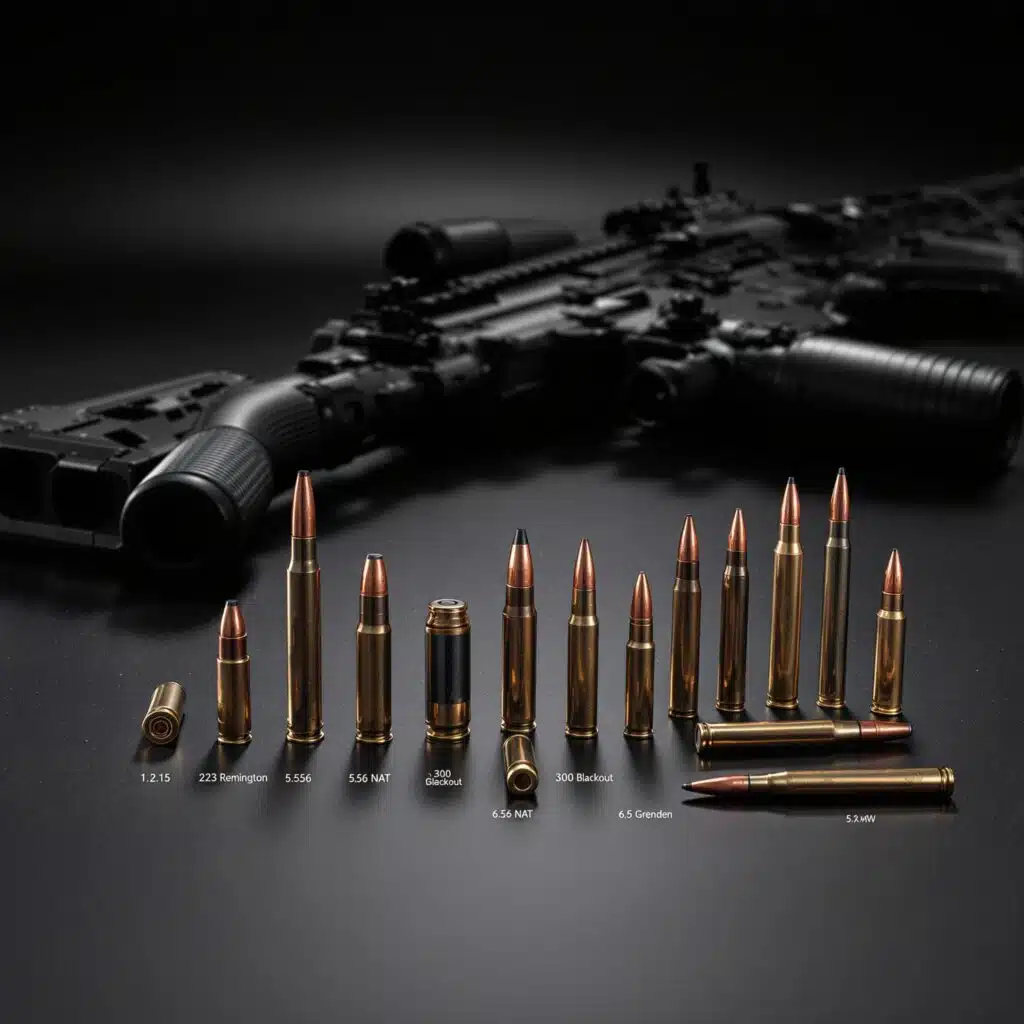

One of the things I still love about the AR-15 platform after building them for over twenty years is that it’s really a family of rifles disguised as one. The lower receiver is the serialized firearm. Everything above it — the upper receiver, barrel, bolt carrier group — can be swapped to run a completely different caliber. Pop two pins, pull the upper off, drop a new one on, and you’re shooting something entirely different.
We build complete uppers in multiple calibers here at our shop in Idaho, and the most common question we get from customers is some version of “which caliber should I go with?” The answer depends entirely on what you’re trying to do. So let me walk through the calibers we work with and give you the honest rundown on each one.
This is where most people start, and for good reason. The 5.56/.223 is the native caliber of the AR-15 platform. Ammo is everywhere, it’s the cheapest centerfire round you’ll find most days, and recoil is light enough that pretty much anyone can shoot it comfortably.
A couple things worth knowing. The 5.56 NATO and .223 Remington are similar but not identical. A 5.56 chamber runs at higher pressure than .223. If your barrel is chambered in 5.56 NATO, you can safely shoot both. If it’s chambered in .223 Remington only, stick with .223. Most of our barrels are chambered in 5.56 or .223 Wylde — the Wylde chamber is designed to safely handle 5.56 pressures while maintaining the tighter tolerances of a .223 chamber for better accuracy. It’s the best of both worlds, and it’s what I recommend for most builds.
For range use, home defense, varmint hunting, and general purpose shooting, 5.56/.223 does the job. The trajectory is flat out to 300 yards, follow-up shots are fast because recoil is minimal, and a standard 30-round magazine keeps you in the fight at the range without constant reloads. There’s a reason this has been the default for decades.
Where it falls short: terminal performance on medium to large game beyond about 200 yards, and ballistic performance past 500 yards. The lightweight bullets (typically 55 to 77 grains) just run out of energy at distance. That’s where the other calibers earn their place.
The .300 AAC Blackout is probably the most popular alternative caliber on the AR-15 platform right now, and for good reason. It was designed from the ground up to do two things well: run reliably in short barrels and perform exceptionally with a suppressor.
Here’s what makes 300 Blackout appealing from a build standpoint — it uses the same bolt carrier group, same magazines, and same lower receiver as 5.56. The only thing that changes is the barrel. That makes it one of the easiest caliber swaps you can do. We build a lot of 300 Blackout uppers on 7.5-inch and 10.5-inch pistol barrels for exactly this reason.
The caliber runs in two flavors: supersonic (typically 110-125 grain bullets around 2,200 fps) and subsonic (200-220 grain bullets around 1,050 fps). Supersonic loads give you respectable terminal performance for hunting and defense out to about 200 yards. Subsonic loads paired with a suppressor are about as quiet as a semi-auto centerfire rifle gets — and they hit hard at close range because you’re pushing a heavy .30 caliber bullet.
The tradeoff: 300 Blackout is not a long-range caliber. Past 200 yards, the trajectory drops off significantly compared to 5.56. And the ammo costs more — roughly double what you’ll pay for .223 on a good day. It’s a specialized tool, and it does its specialty extremely well.
One critical safety note I always mention to customers: 300 Blackout rounds will physically chamber in a 5.56 barrel. If you fire a .30 caliber bullet through a .22 caliber bore, the result is a catastrophic failure. If you have both calibers, mark your magazines clearly. I’ve seen photos of what happens when people don’t. It’s not pretty.
The AR-9 platform — a 9mm Luger AR-15 — is something we’ve been building a lot of lately. It uses a blowback or radial-delayed system with a dedicated 9mm bolt carrier group and a barrel chambered in 9mm. Most 9mm AR builds run Glock-compatible or Colt-pattern magazines through a dedicated lower receiver or a magwell adapter.
We build 9mm complete uppers that pair with dedicated 9mm lowers, and they’re a blast to shoot. Recoil is soft, ammo is cheap (the cheapest centerfire option by a wide margin), and the report is low enough that it’s pleasant even at indoor ranges. With a 7.5-inch barrel and a suppressor, a 9mm AR is one of the most enjoyable firearms to shoot, period.
For home defense, a 9mm PCC with a short barrel and a weapon light gives you a stable platform that’s easier to aim than a handgun, with less overpenetration risk than a rifle caliber. That’s a meaningful advantage in a home environment with drywall and family members in other rooms.
Where it falls short: this is a pistol caliber. Effective range tops out around 100-150 yards in practical terms. It’s not a hunting round. It’s not a long-range round. But within its lane, it’s hard to beat for the money.
We have our 9mm PCC and pistol upper receivers if you want to see what we’re currently building.
The 6.5 Grendel is the caliber I recommend when someone tells me they want to stretch their AR-15 past 500 yards or hunt deer-sized game. It does both of those things better than anything else you can run through a standard AR-15 lower.
The Grendel pushes a high-BC 6.5mm bullet (typically 123 to 130 grains) at moderate velocities. It doesn’t look impressive on paper compared to a .308 Winchester, but the ballistic coefficients of those long, sleek 6.5mm bullets mean it retains velocity and energy downrange remarkably well. At 800 yards, a 123-grain Grendel is still carrying more energy than a lot of people expect. The wind drift numbers are noticeably better than 5.56 at distance.
For deer hunting, the Grendel is genuinely effective out to 300-400 yards with proper bullet selection. Several states that require a minimum caliber for deer hunting accept the 6.5 Grendel where they won’t allow .223. That opens up the AR-15 platform to hunters in states with those restrictions.
The tradeoff: the Grendel uses a different bolt face than 5.56, so you need a Grendel-specific bolt carrier group. You can’t just swap a barrel — the bolt has to match. Magazine capacity is also reduced because the case is fatter than 5.56; you’re looking at about 26 rounds in a standard-size AR magazine. And ammo selection is more limited and more expensive than 5.56, though it’s gotten better in recent years.
For someone who wants one AR-15 that can do range work, hunt medium game, and reach out to distance, the 6.5 Grendel is the caliber I’d point them toward. We build 6.5 Grendel complete uppers and can walk you through barrel length and twist rate options if you call us.
After building rifles in all of these calibers for years, here’s how I’d frame the decision:
5.56/.223 if you want one do-everything caliber with cheap ammo, light recoil, and the widest selection of barrels, BCGs, and ammunition on the planet. This is the right answer for most people.
300 Blackout if you’re building a short-barreled pistol or SBR, especially if you’re running suppressed. It’s purpose-built for that role and it excels at it.
9mm if you want the cheapest ammo possible, the softest recoil, and a platform that’s ideal for range training and home defense.
6.5 Grendel if you need to reach past 500 yards or want to hunt deer-sized game with your AR-15. It extends the platform’s capability in ways that 5.56 simply can’t.
The beauty of the AR-15 is that you don’t have to choose just one. Build or buy an upper in each caliber you need, and swap between them in seconds. That’s the whole point of the platform, and it’s why we’ve been building them for over two decades.
Got questions about which caliber fits your build? Call us at (888) 912-6486 or email [email protected].