
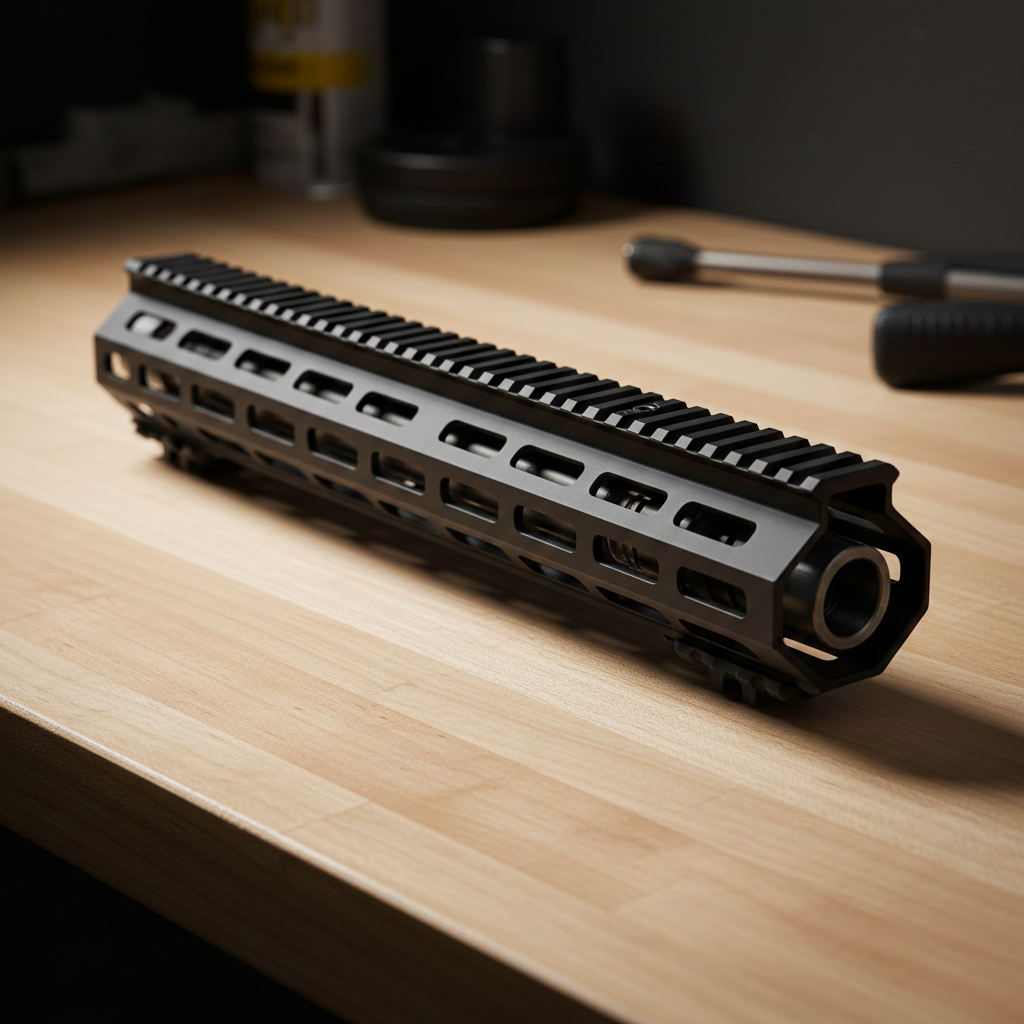

I get asked about free float handguards in our shop probably more than any other single topic, so let me break down what’s actually happening mechanically — because a lot of the information floating around online misses the point.
On a standard mil-spec AR-15 with a front sight base (your classic A2 setup), the handguards are held in place by a delta ring at the rear and the handguard cap at the front sight base. That means the handguard is physically touching the barrel assembly at two points. Every time you grip the handguard, lean it against a barricade, or cinch down a sling, you’re putting pressure on the barrel through those contact points.
A free float handguard works differently. The barrel nut threads onto the upper receiver, and the handguard attaches to that barrel nut — and that’s it. Nothing touches the barrel. The barrel hangs inside the handguard with an air gap all the way around. You could squeeze the handguard as hard as you want, rest it on a concrete wall, clamp a bipod to it — the barrel doesn’t know and doesn’t care.
That distinction is the entire point.
Here’s the thing most people don’t fully grasp: your barrel vibrates when you fire. Every barrel does. It’s called barrel harmonics, and it’s a predictable oscillation pattern that happens the instant the round ignites. A well-made barrel will vibrate the same way every time, which means the muzzle is in the same position at the moment the bullet exits. That’s how you get consistent groups.
The problem with a drop-in handguard is that any external pressure on the barrel changes that harmonic pattern. And it doesn’t take much. If you rest a standard drop-in handguard on a sandbag at the range, you’re pushing on the barrel. Move your hand position forward or back, and you’ve changed the pressure point. Your point of impact shifts — maybe just an inch at 100 yards, but at 200 or 300, that turns into a real problem.
I’ve seen this firsthand with customers who come in frustrated that their rifle “won’t hold zero.” They’ve spent money on a nice barrel, good optic, quality ammo — and they’re still throwing inconsistent groups. Nine times out of ten, once we swap them to a free float setup, the groups tighten up immediately. The barrel was fine all along. It just needed to be left alone.
With a free float handguard, your grip position, sling tension, bipod pressure, and shooting platform don’t affect the barrel. The only things touching that barrel are the barrel nut and the upper receiver — exactly as designed.
After building thousands of uppers over the years, I can tell you that heat management is where a lot of people underestimate what a free float handguard does for them.
That air gap between the barrel and the inside of the handguard isn’t just for accuracy — it acts as a heat channel. As the barrel heats up during firing, that air circulates and carries heat away from the barrel surface. On a standard drop-in handguard, the contact points create hot spots and trap heat against the barrel.
This matters most on our shorter builds. If you’re running a 7.5-inch or 10.5-inch pistol upper, heat builds fast — especially on a range day where you’re running drills or doing mag dumps. A free float handguard on a short barrel gives you noticeably better heat dissipation, which keeps barrel temperatures lower during sustained fire. Cooler barrels last longer and maintain accuracy better over the life of the rifle. It’s not dramatic per individual session, but over thousands of rounds, the difference in barrel life adds up.
Most of our free float handguards also have venting cuts along the top and sides specifically to promote airflow. Those aren’t just for looks — they serve a real thermal management purpose.
If you’ve been around AR-15s long enough, you remember when Picatinny quad rails were the standard for free float handguards. They worked, but they were heavy and bulky. A full-length quad rail on a 15-inch handguard added serious weight and gave you cheese-grater edges everywhere you didn’t have accessories mounted. Most guys ended up covering three of the four rail sections with rail covers anyway.
M-LOK changed the game. The handguard itself is smooth and slim, and you only add mounting surface where you actually need it. The weight savings are real — our M-LOK handguards are noticeably lighter than comparable quad rails, and the ergonomics are just better for extended shooting.
In terms of what people actually mount: a weapon light is the most common (usually at the 10 or 2 o’clock position), followed by an angled foregrip or hand stop for C-clamp grip shooters. Guys running night vision will add an IR laser/illuminator up top. The point is, M-LOK gives you the flexibility to set up your rifle for how you actually use it without carrying the weight of four full Picatinny rails.
Check out our M-LOK handguard collection — we manufacture these in-house right here in Idaho.
If you’re working with a flat-top upper that has a low-profile gas block, installing a free float handguard is straightforward. Remove the old barrel nut (or use the one that came with the handguard), torque the new barrel nut to spec, slide the handguard on, and tighten it down. Most of our handguards use a clamping system that makes alignment simple.
If you’re converting an A2-style upper with a front sight base and delta ring, it’s more involved. You’ll need to remove the front sight base, drive out the taper pins, remove the delta ring assembly, and install a low-profile gas block. It’s not difficult work if you have the right tools (an armorers wrench, a vise block, and pin punches), but it’s definitely a step beyond basic assembly.
For anyone who doesn’t want to deal with the barrel work, we sell complete upper receivers with free float handguards already installed and properly torqued. You get the accuracy and modularity benefits without needing any tools beyond two takedown pins.
Not all free float handguards are equal, and there are a few things worth paying attention to:
Material. Most handguards are made from either 6061-T6 or 7075-T6 aluminum. 7075 is stronger and more impact-resistant, but also slightly heavier and more expensive. For most shooters, 6061-T6 is more than adequate — it’s what the majority of quality handguards on the market use, including ours. If you’re hard-use military or law enforcement, 7075 is worth the premium.
Length. Your handguard length needs to work with your barrel length and gas system. A 15-inch handguard on a 16-inch barrel with a mid-length gas system gives you full coverage and a long grip surface. On a 10.5-inch pistol barrel with a carbine gas system, you’re looking at something in the 9 to 10-inch range. The handguard should extend past the gas block but not past the muzzle device.
Barrel nut and attachment method. Some manufacturers use proprietary barrel nuts that only work with their handguards. Others use a mil-spec barrel nut. Proprietary nuts usually give you a more secure lockup and easier installation, but they tie you to that manufacturer’s system. We use our own barrel nut design that we’ve refined over the years for a solid, repeatable fit.
Inner diameter. This one catches people off guard. If you’re running a suppressor or an adjustable gas block, make sure the handguard’s inner diameter has enough clearance. A tight inner diameter might fit a standard low-profile gas block just fine but not leave room for a suppressor mount or a bulkier adjustable block. Check the specs before you buy — we list inner diameter on all of our product pages for exactly this reason.
Free float handguards for AR-15 builds aren’t a gimmick or a cosmetic upgrade. They solve a real mechanical problem — barrel contact — and they do it while giving you better heat management and a modular platform for accessories. It’s one of those upgrades where, once you’ve run one, you won’t want to go back to a drop-in setup.
If you’ve got questions about which handguard fits your build, give us a call at (888) 912-6486. We’ve been doing this since 2003, and we’re happy to walk you through it.