
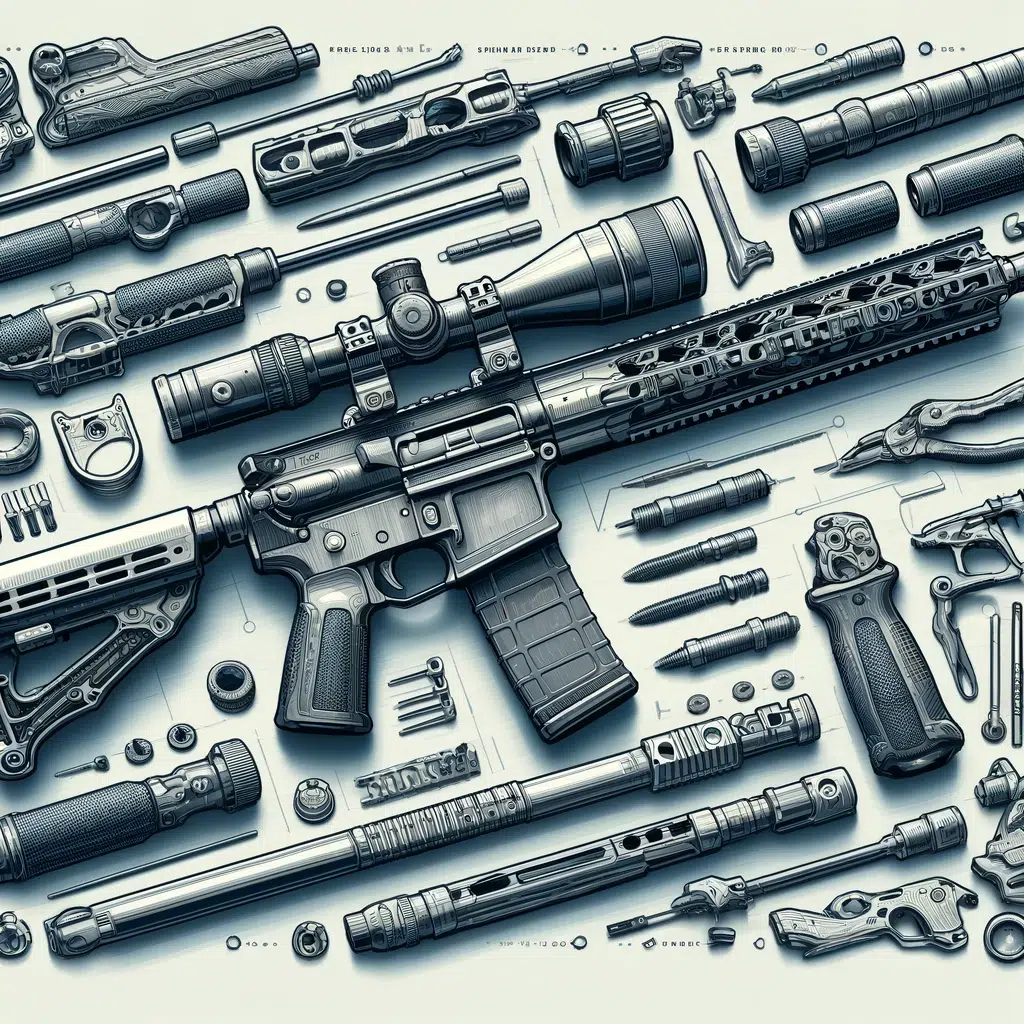

I’ve built a lot of lightweight AR-15s over the years, and the most common mistake I see is people chasing a number on the scale at the expense of a rifle that actually works. You can absolutely build a sub-6-pound AR-15. You can build one under 5 pounds if you really commit. But if it doesn’t run reliably or falls apart after a few thousand rounds, you haven’t built a lightweight rifle — you’ve built a problem.
The goal should be cutting weight where it doesn’t cost you anything in function, and making informed tradeoffs where it does. Let me walk through where the real weight lives in an AR-15 and what’s actually worth changing.
The single biggest weight variable on an AR-15 upper is the barrel. A standard government-profile 16-inch barrel in 5.56 weighs somewhere around 1.5 to 1.8 pounds depending on the manufacturer. A pencil profile or lightweight contour barrel of the same length can come in under a pound.
That’s a half-pound or more from one component. Nothing else on the rifle gives you that kind of return.
Here’s what’s actually happening mechanically. A government profile barrel has extra material under the handguard (where you don’t need it for accuracy) and thins out ahead of the gas block. A pencil profile is thin the entire length. A lightweight or “gunner” profile splits the difference — thin behind the gas block with a slight taper forward.
The tradeoff is thermal mass. A thinner barrel heats up faster and the point of impact starts to shift sooner during sustained fire. I’ve tested this myself on our builds — a pencil barrel shooting controlled pairs or even moderate strings of fire holds accuracy just fine. But if you’re dumping multiple magazines back to back, a pencil barrel will walk its groups before a government profile barrel even gets warm.
For most people — range shooting, hunting, home defense, training classes — a lightweight or pencil barrel is perfectly adequate. You’re not providing suppressive fire from a fighting position. If you’re shooting a 3-round group, waiting 30 seconds, shooting another, a pencil barrel will group just as well as a heavy barrel at practical distances. The guys who need a heavy barrel know who they are, and they probably aren’t trying to build a lightweight rifle.
We offer several barrel profiles across our AR-15 barrel lineup, and I’m always happy to talk through which contour makes sense for a specific build.
After the barrel, the handguard is the next place to find serious weight savings. A full-length aluminum quad rail can weigh 12 to 16 ounces. A slim M-LOK free float handguard of the same length can weigh 7 to 9 ounces. That’s nearly a half-pound difference, and you’re getting a better handguard in the process.
The key is the profile. You want a handguard with a narrow inner diameter — just enough to clear the barrel and gas block with room for airflow — and M-LOK slots only where you actually need mounting surface. You don’t need a full Picatinny rail on top if you’re running a flat-top upper with your optic on the receiver. A short section of rail or M-LOK at the 12 o’clock position near the muzzle for a front sight is enough. Everything else can stay smooth and slim.
One thing I’d caution against: don’t go so thin and light on the handguard that it flexes under normal use. I’ve handled some ultralight handguards from other manufacturers that twist noticeably when you torque on them. If you’re mounting a weapon light or a bipod, you need the handguard to be rigid enough that those accessories hold zero. Our M-LOK handguards are designed to be lightweight but stiff — we didn’t skeletonize them to the point where they give under pressure.
Check out our M-LOK handguard collection — most of them are well under 10 ounces even at 15-inch lengths.
This is where I see people make bad decisions in the name of weight savings. Yes, lightweight bolt carrier groups exist. Titanium carriers, skeletonized carriers, low-mass carriers — they’ll save you 2 to 4 ounces over a standard carrier.
Here’s my honest take after building thousands of rifles: the bolt carrier group is the heart of the rifle’s operating system. It’s the component that takes the most abuse on every single round fired. The carrier slams rearward under gas pressure, strips a round from the magazine, chambers it, and locks into battery — thousands of times over the life of the rifle. I want mass there. I want durability there.
A standard mil-spec bolt carrier group weighs about 11.5 ounces. A lightweight carrier might save you 3 ounces. That’s less than a quarter pound — from the one component where reliability matters most. For a competition rifle that sees a few hundred rounds at a match and gets babied, sure, run a lightweight BCG. For anything you might depend on, I’d keep the standard carrier and find your weight savings elsewhere.
If you do go lightweight on the carrier, understand that you’re changing the timing of the entire gas system. Less bolt carrier mass means the carrier moves faster, which can increase bolt bounce, increase the rate at which the action cycles, and change your ejection pattern. You may need to adjust your buffer weight and spring to compensate. It’s not plug-and-play.
A standard M4-style collapsible stock weighs around 8 to 10 ounces including the buffer tube. A minimalist stock — the kind with a thin skeleton frame and a rubber buttpad — can weigh 4 to 6 ounces. That’s an easy quarter-pound savings with minimal functional impact.
The one thing a lot of lightweight stocks sacrifice is cheek weld. Those thin, skeletonized designs don’t give you much surface to rest your face against consistently. If you’re running a red dot or low-magnification optic, that might not matter much. If you’re behind a magnified scope where consistent cheek weld affects your eye relief and sight picture, a slightly heavier stock with a better cheek piece might actually make you more accurate. Weight savings that make you shoot worse aren’t really savings.
For the buffer system, the standard carbine buffer weighs about 3 ounces. Lighter buffers are available, but again, you’re changing the timing of the action. If you went with a lightweight BCG and a lightweight buffer, you’ve reduced the total reciprocating mass significantly, and you may end up with reliability issues — short stroking with weak ammo or beating itself to death with hot loads. Keep the buffer weight matched to the rest of your system.
Standard forged aluminum AR-15 lowers weigh around 8 to 9 ounces stripped. Billet lowers can be slightly lighter or heavier depending on the design. Polymer lowers exist and can save you 2 to 3 ounces, but I won’t sugarcoat this — I don’t build with polymer lowers and I don’t recommend them. The lower receiver takes stress at the buffer tower, the pivot and takedown pin holes, and the grip screw boss. I’ve seen cracked polymer lowers. Aluminum doesn’t crack under normal use.
For the pistol grip, swapping from a standard A2 grip to a lighter option is an easy win. A Magpul K2 or similar weighs about 2 ounces less than a standard grip. It’s not a huge number, but it adds up when you’re trimming from every component.
Let me put some rough numbers to a lightweight 16-inch 5.56 build versus a standard one:
| Component | Standard | Lightweight | Savings |
|---|---|---|---|
| Barrel (16″, gov’t vs pencil) | ~26 oz | ~14 oz | ~12 oz |
| Handguard (15″, quad vs slim M-LOK) | ~14 oz | ~8 oz | ~6 oz |
| Stock (M4 vs minimalist) | ~10 oz | ~5 oz | ~5 oz |
| Grip (A2 vs lightweight) | ~4 oz | ~2 oz | ~2 oz |
| Muzzle device (standard A2 vs slim) | ~3 oz | ~1.5 oz | ~1.5 oz |
That’s roughly 26 ounces — over a pound and a half — from five components, without touching the BCG, lower receiver, or anything that compromises reliability. A standard AR-15 runs about 6.5 to 7 pounds unloaded. Trim 1.5 pounds from those five areas and you’re in the 5 to 5.5 pound range before optic and accessories.
I’ve handed customers a 5.5-pound rifle and watched them immediately bolt on a 12-ounce weapon light, an 8-ounce optic, a 4-ounce sling, a 6-ounce vertical grip, and a loaded 30-round magazine at about 15 ounces. Now the 5.5-pound rifle weighs 8.3 pounds.
Be intentional about what goes on a lightweight build. A weapon light is non-negotiable on a defensive rifle — that stays. An optic is necessary. A sling is smart. But do you need a magnified LPVO, or will a red dot at 3 ounces do the job? Do you need a bipod, or is this a rifle you’ll shoot offhand and from barricades? Every accessory choice either preserves the lightweight advantage you worked for or erases it.
If someone calls our shop and says they want to build the lightest AR-15 possible, I tell them to focus on three things: barrel, handguard, and stock. Those three components account for the vast majority of weight difference between a standard rifle and a lightweight build. Get those right and leave the BCG, buffer system, and lower alone. You’ll end up with a rifle that’s genuinely light, genuinely reliable, and doesn’t need constant tuning to function.
And if you don’t want to piece it together yourself, we build complete lightweight uppers that are already sorted — barrel, handguard, BCG, and charging handle, ready to drop on your lower.
Questions about your build? (888) 912-6486 or [email protected].